DrawMotive editor
@drawmotive/editor embeds a visual diagram editor in your web application. Start with TextGraph or an empty canvas, edit shapes, labels and connections, then save an editable document or export PNG/SVG. The public editor runs in the browser without an account or rendering service.
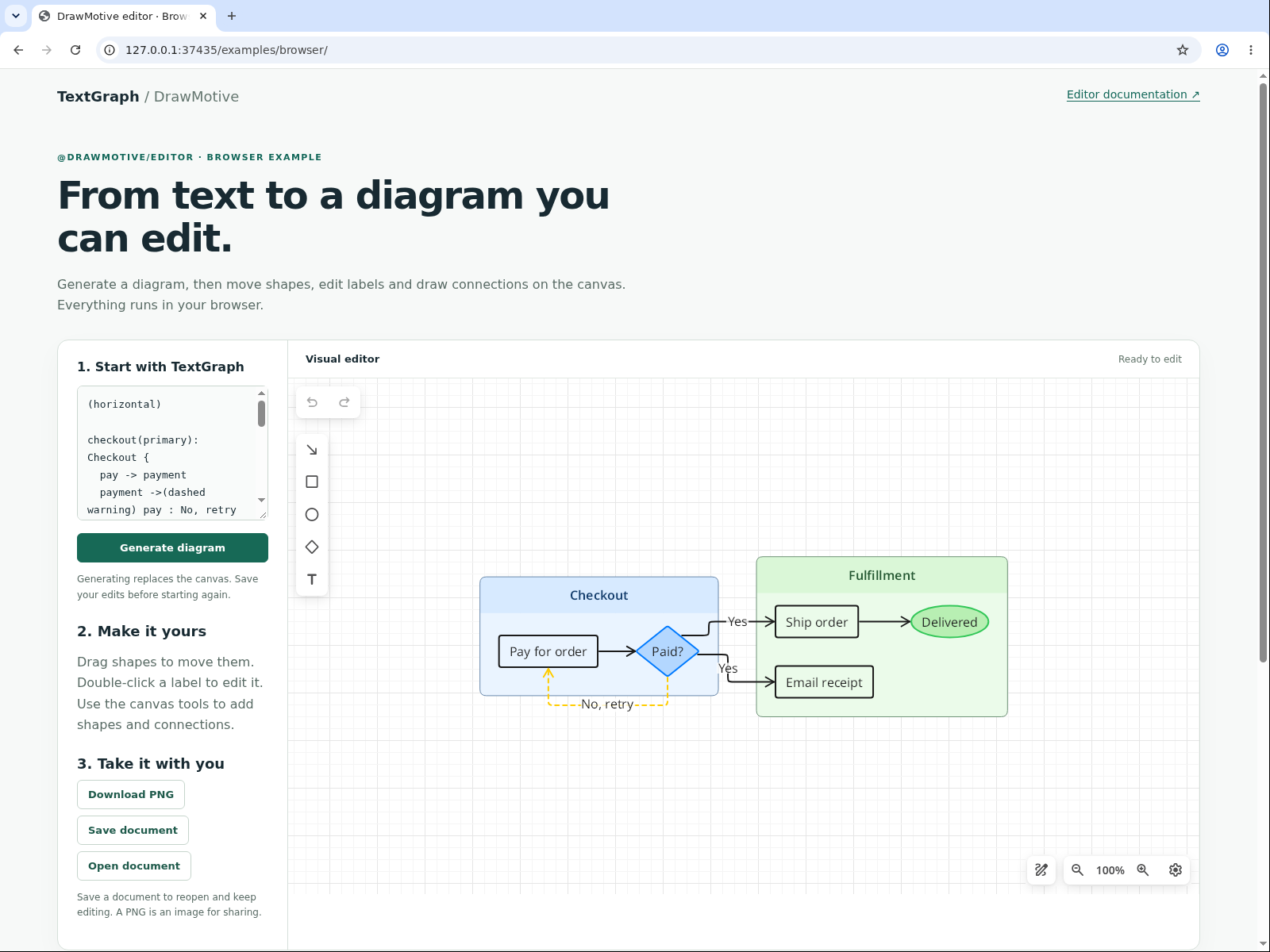
Run the visual editor SDK demo →
From TextGraph to visual editing
The Playground previews an image as you edit TextGraph. DrawMotive creates a separate editable document from that source, then lets people work directly with its shapes, labels and connections. This is intentionally a one-way workflow: canvas changes belong to the saved document and do not rewrite TextGraph. Generating from source again replaces the document; it does not merge with earlier canvas edits.
| What you need | Package |
|---|---|
| Validate TextGraph and render PNG/SVG in a browser, Node.js or a Worker; render PNG in React | @drawmotive/textgraph |
| Edit diagrams visually and save editable documents in a web page | @drawmotive/editor |
Install and create
npm install @drawmotive/editor@0.3.2
npx drawmotive-copy-assets public/editor
Copy the complete runtime again after each upgrade. For Vite, run the copy command in predev and prebuild. Serve the application over HTTPS or localhost.
<div id="editor" style="height: 600px"></div>import { createEditor } from '@drawmotive/editor';
const editor = await createEditor({
container: document.querySelector('#editor'),
assetBaseUrl: '/editor/',
});
await editor.replaceTextGraph('User -> Application -> Database');
await editor.fitViewport();Creation resolves when the empty scene and storage are ready. Replacement and viewport fitting are separate operations. To start with a blank canvas, omit the two calls after creation. The canvas mounts directly into the host document; give its container an explicit height. A page supports one active editor. Await disposal before creating its successor; concurrent creation rejects with EditorAlreadyMounted.
Save, reopen and export
const snapshot = await editor.exportSnapshot({ formats: ['raw', 'png', 'svg'] });

// Persist snapshot.raw in your application's storage.
await editor.replaceDocument(snapshot.raw);
await editor.fitViewport();

// PNG is an object; its base64 property contains the image bytes.
const imageUrl = `data:image/png;base64,${snapshot.png.base64}`;
const svgText = snapshot.svg;
All requested formats come from one document revision. raw is an opaque base64 editable document, not TextGraph source. PNG contains base64, pixel width/height, scale, and logical displayWidth/displayHeight; SVG is a string. Raw-only export does not render an image. Rendering defaults to scale: 1 and padding: 10; set render: { scale, maxWidth, padding } when exporting to change those options.
Storage defaults to temporary memory. To retain a local document across sessions, create the editor with persistence: { mode: 'persistent', namespace: 'my-app', documentId: 'drawing-id' }. Persistent storage runs in a Dedicated Worker and survives disposal. Your application owns external saving and document identity. Exporting a snapshot does not mark it saved.
An editable PNG
To keep the drawing and its preview in one file, embed the document explicitly:
const snapshot = await editor.exportSnapshot({
  formats: ['png'],
  render: { scale: 2, maxWidth: 1920, padding: 10 },
  png: { embedDocument: true },
});

// Persist the complete PNG bytes, then reopen their base64 representation.
await editor.replacePngDocument(snapshot.png.base64);
await editor.fitViewport();
embedDocument defaults to false. Ordinary PNG and SVG exports are images; preserve raw or use an embedded PNG to reopen canvas edits. Ordinary PNGs without an embedded document and damaged imports are rejected without clearing the current drawing.
Replace a diagram
await editor.replaceTextGraph('Draft -> Review -> Approved');
await editor.fitViewport();

// Explicitly start a new empty document when needed.
await editor.clearDocument();
Successful replacements reset selection and undo history. Save canvas edits before replacing a document. Invalid imports preserve it. An unfinished gesture or text edit reports EditorBusy; finish or cancel that interaction before trying again.
State and host controls
Subscribe to state when your host needs save indicators, history controls or close confirmation:
let savedRevision = null;
function showSaveState(state) {
  const dirty = state.revision !== null && state.revision !== savedRevision;
  // Update your host UI from dirty, busy, health, canUndo and canRedo.
}
const unsubscribe = editor.onStateChanged(showSaveState);

async function saveDocument() {
  const snapshot = await editor.exportSnapshot({ formats: ['raw'] });
  await persistDocument(snapshot.raw); // Your application's storage operation.
  savedRevision = snapshot.revision;
  showSaveState(await editor.getState());
}
State subscriptions immediately receive the current state. Revisions are opaque and local to an instance. Compare the current revision with the revision whose save completed: an older save acknowledgment must not clear later edits. Selection, zoom and pan do not change the document revision. The host decides whether its initial empty document needs saving.
The host provides its own toolbar, menus and save controls. Call setTool('rectangle'), undo(), redo() and setPreferences({ showGrid: true }) from those controls, and use state subscriptions to update their enabled state. setEditingEnabled(false) provides a read-only interaction policy. See the package API guide for the available controls and text input policies.
Lifecycle and failures
Create the editor after your framework mounts its container. signal cancels startup; after creation, explicitly release subscriptions and dispose the instance when the component unmounts:
const controller = new AbortController();
const editor = await createEditor({
  container,
  assetBaseUrl: '/editor/',
  signal: controller.signal,
});

// On component teardown, release any state subscription as well.
await editor.dispose();
Call the function returned by onStateChanged() to unsubscribe. The module can be imported during server rendering; creation requires browser DOM, Web Crypto and Dedicated Workers. startupTimeoutMs defaults to 120000 and disposeTimeoutMs defaults to 5000. Document operations return ordered promises without transport deadlines or automatic retries.
A failed local transaction can report health: 'faulted' and revision: null; a successful explicit document replacement restores the instance. External storage failures remain the host's responsibility. Disposal waits for pending operations, removes the native canvas and releases Workers and storage resources. Unconfirmed cleanup rejects with DisposeCleanupUnconfirmed and blocks another editor until page reload.
Hosting and supported scope
Set assetBaseUrl to the copied runtime directory, including any deployment prefix, such as /my-app/editor/. Serve .wasm as application/wasm and deploy all copied files, including licenses and notices. Do not remove or rewrite runtime files: startup verifies their hashes.
For a restrictive Content Security Policy, permit the actual Worker and resource origins through worker-src and connect-src, WebAssembly execution (wasm-unsafe-eval), and the native canvas styles. The SDK's default Worker URLs resolve relative to its modules at ../dist/workers/; preserve the package's src and dist/workers layout when serving unbundled modules. Copying runtime assets does not relocate those Workers. Bundled applications must emit both Worker files or provide explicit workerUrls; see the package guide.
The public build provides local editing without authentication or a collaboration connection. Files, accounts, external persistence and product actions belong to the host. Current Chromium is the verified visual-runtime target; Firefox/WebKit, mobile devices and embedded hosts require their own verification.
The package README and TypeScript declarations define the full 0.3.2 API. Upgrade SDK code, Workers and copied runtime assets together.